
Opening: what the EYES saw
Across Europe, youth work is growing fast, but many organisations still struggle to turn inspiring ideas into projects that actually live. E.Y.E.S., the Entrepreneurial Youth Education Seminar, was born to close exactly that gap. Over eight days in Kékkút, in the heart of the Balaton Uplands National Park in Hungary, 23 youth workers from seven countries trained their EYES not on dreams alone, but on the practical skills that move an idea from sticky note to community impact.
This article gathers the entrepreneurial-education solutions we delivered, our objectives and outcomes, and the methods we believe other youth organisations can adopt straight away.
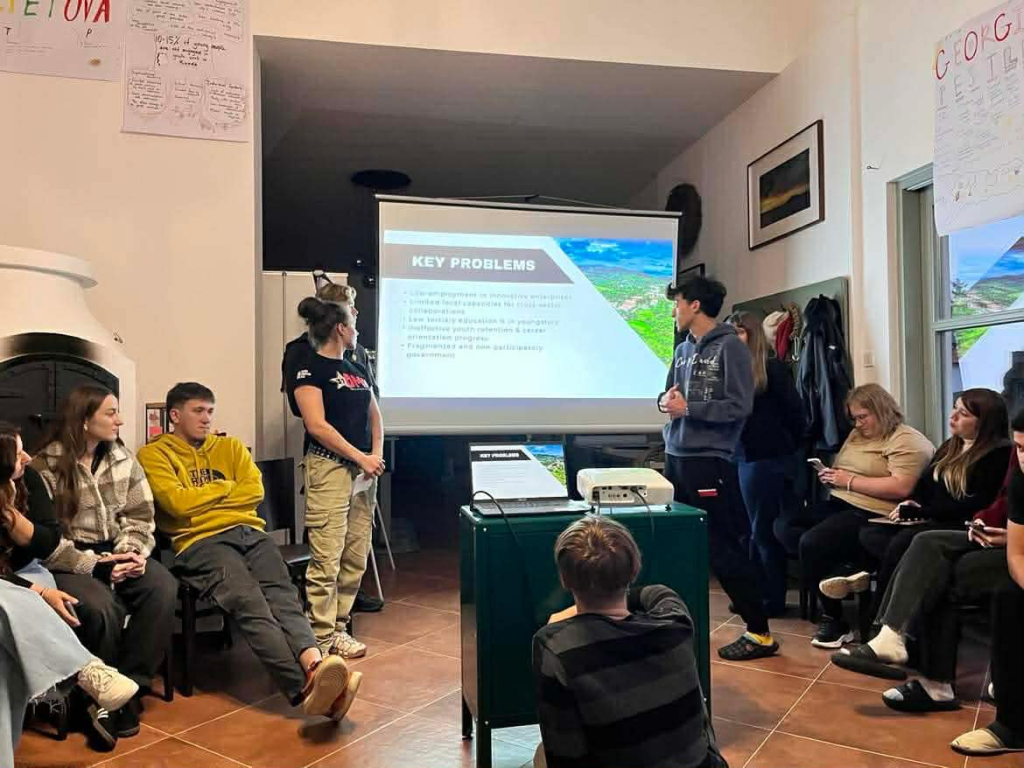
Day 1 — the project map: setting expectations and the learning journey together.
1. The vision behind E.Y.E.S.
Why entrepreneurship competence — and why now?
Our needs analysis, co-developed with our Slovenian partner Podjetniška akademija and confirmed across the partnership, kept pointing to the same blind spot. Youth workers are trained in facilitation, inclusion and pedagogy, but rarely in the entrepreneurial habits that decide whether a project survives its first three months: identifying a real need, planning resources honestly, communicating value, and adapting when reality pushes back.
We treat entrepreneurship competence not as a business specialism but as one of the EU’s eight key competences for lifelong learning, the bridge between ideation and implementation. It bundles creativity, problem-solving, adaptability, resilience and responsibility into the everyday work of a youth organisation. In short: it lets a youth worker move from “wouldn’t it be great if…” to “here is what we will do on Monday”.
Project objectives
- Equip 23 youth workers with practical, transferable entrepreneurial skills they can use the day they get home.
- Build a more pragmatic mindset across the partnership — shifting from the “dreamer” attitude to feasible, value-creating projects.
- Improve the quality of youth work through innovative, multidisciplinary, non-formal methods.
- Strengthen a long-term European cooperation network capable of producing follow-up initiatives after the project ends.
- Contribute to the EU Youth Strategy and to Youth Goals #1 Connecting EU with Youth, #8 Quality Learning, #9 Space and Participation for All, and #11 Youth Organisations & European Programmes.
The partnership
E.Y.E.S. was built on a deliberately diverse partnership: experienced NGOs sat next to younger, fresher organisations, and an entrepreneurship academy sat next to community-based rural youth associations. This mix is what gave the training its multi-perspective character.
| Organisation | Country | Role |
| ABOVE Alapítvány a Fiatalok Jövőjéért | Hungary | Coordinator & host organisation |
| Podjetniška akademija (Podjetniška akademija, društvo za izobraževanje o podjetništvu) | Slovenia | Partner – entrepreneurship expertise |
| ASSOCIAZIONE CONNECTING EUROPE | Italy | Partner – community & rural youth work |
| POP HUB — Associação | Portugal | Partner – design thinking & storytelling |
| KUNDA SOTSIAAL- JA TERVISEKESKUS MTÜ | Estonia | Partner – project management experience |
| BITISI | Georgia | Partner – international youth engagement |
| Youth Together Projects | Lithuania | Partner – sustainability & a young group |
2. The activity at a glance
The core mobility was an 8-day international training course held from 3 to 10 October 2025 at the Oszterház in Kékkút, a quiet village inside the Balaton Uplands National Park. The venue, partly powered by solar energy, gave the group exclusive use of an accommodation building and a freshly renovated workshop space, with the surrounding nature serving as a second classroom. After the mobility, every participant carried out a local follow-up or implementation activity in their home country, and the partnership reconvened online six weeks later on 30 November 2025 to co-create a final reflection on a Miro board, evaluate impact, and map future cooperation.

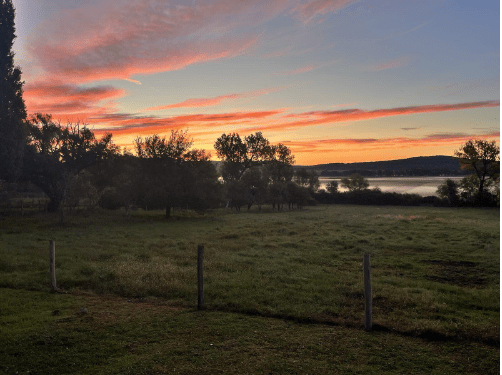
The Oszterházgarden in Kékkút at golden hour – this quiet, nature-immersed venue served as the project’s second classroom.
Programme arc
The eight days followed a clear narrative arc from foundations, through tools, to a real-stakes simulation, and finally to dissemination and closure. Day 1 was an arrival and team-building evening, dedicated to breaking the ice and establishing the safe learning environment that the rest of the week depended on. Day 2 laid the entrepreneurial foundations: an Expectations–Fears–Contributions board, a Word Café on what entrepreneurship actually means in youth work, and the theory of entrepreneurship competence as a key competence for lifelong learning. Day 3 moved from theory to practice with needs analysis and market research, an interactive masterclass by serial entrepreneur Nejc Konjevič, and an Elevator Pitch workshop based on the Nancy Duarte method, closed by an Intercultural Night where every nation cooked, danced and shared. Day 4 was the rural-youth-work case-study “competition” in mixed international teams, followed by a Lake Balaton trip to recharge and the halfway reflection. Day 5 went deeper into the toolkit: Design Thinking, the RACI matrix, cashflow and budgeting, the Triple Layer Business Model Canvas, and a 0–100% Spectrum Debate to sharpen critical thinking ahead of the main project. Day 6 was the centrepiece, the full-day Youth Development Project where teams designed a 12-month plan for one of the partner organisations. Day 7 turned the energy outward: finalising project products, preparing dissemination materials, and ending with a Hungarian farewell dinner. Day 8 closed the loop with the Youthpass ceremony, follow-up coordination, and departures.
Methodology: non-formal, multidisciplinary, hands-on
Every activity was designed to tap on participants’ existing experience and immediately translate new knowledge into practice. Interactive lectures were the smallest part of the week; the bulk of time was spent in mixed international working groups, alternating between structured workshops, case work, peer-to-peer learning and reflection. Each day ended in fixed “home groups” where progress was reflected and documented in personal notebooks, building the foundation for the Youthpass certificates issued at the end.
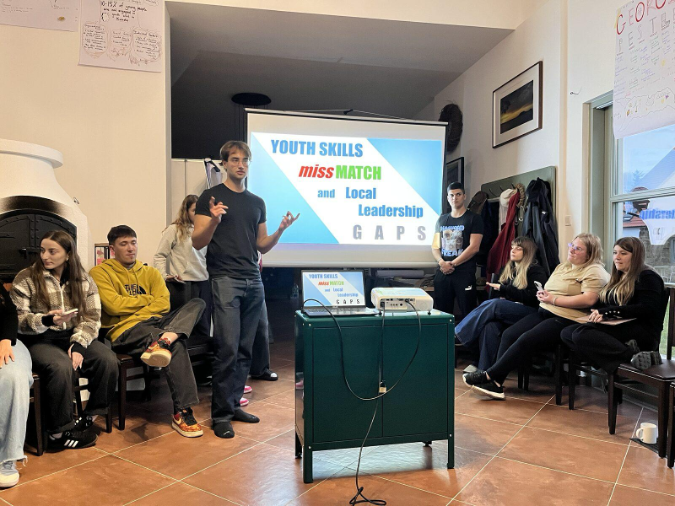
Framing the problem: “Youth Skills missMATCH and Local Leadership GAPS” – the kind of structured input that opened each toolkit session.
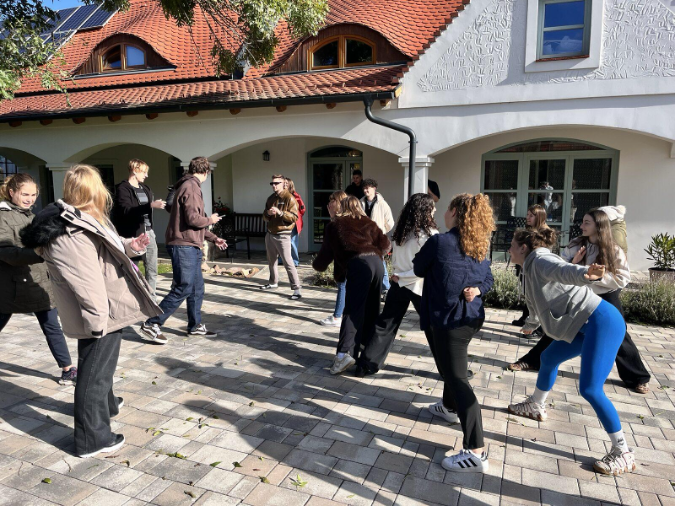
Outdoor energiser between sessions – keeping bodies and minds alert.
3. The entrepreneurial toolkit
Below are the eight core methods participants took home. Each was first introduced through a short input session, then practised on a real youth-work case, and finally reflected on collectively. The intention was simple: nothing leaves the training room as theory alone.
| PESTLE & SWOT analysis | Mapping the regional, social and economic context where an idea is born. |
| Problem Tree | Separating root causes from consequences before designing any intervention. |
| Design Thinking & ‘How Might We’ | Turning a vague pain-point into a clear, human-centred opportunity. |
| Elevator Pitch (Duarte method) | Communicating an idea clearly in 60 seconds – fewer, organised ideas beat many chaotic ones. |
| RACI Matrix | Splitting responsibility across a youth-work team: Responsible, Accountable, Consulted, Informed. |
| SMART goals & GANTT planning | Translating big ambitions into measurable steps with realistic deadlines. |
| Cashflow & basic budgeting | Designing a 12-month money flow – a survival skill for any small NGO project. |
| Triple Layer Business Model Canvas | Sustainable evolution of the BMC: economic, environmental and social layers in one picture. |
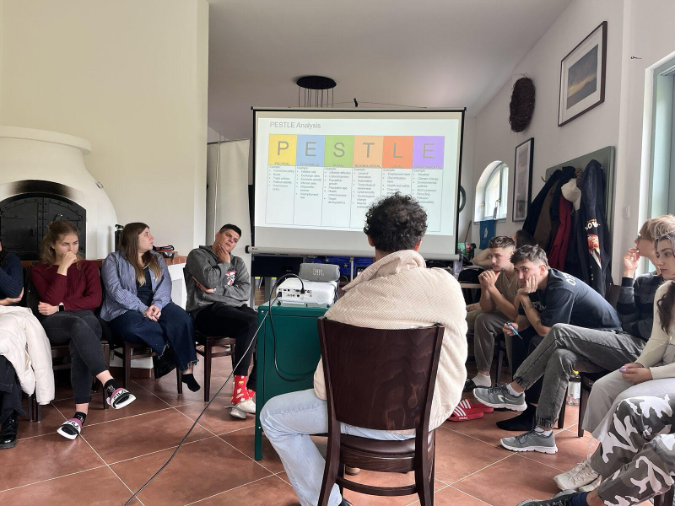
PESTLE analysis in plenary – mapping the political, economic, social, technological, legal and environmental context country by country.
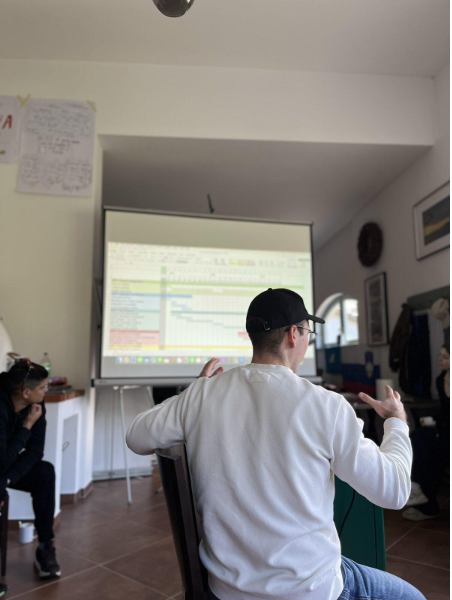
Walking the group through a real GANTT chart – translating SMART goals into a calendar with dependencies.
Two signature moments
Interactive masterclass with Nejc Konjevič. A serial entrepreneur and educator from the Slovenian Entrepreneurship Academy joined the group for a hybrid session combining personal stories of failure and success with a live Q&A. His message – “perfectionism is the enemy of completion” – became one of the most quoted lines of the week.
Youth Development Project (Day 6). A full-day, real-stakes entrepreneurial challenge. Working in international groups of four, participants designed a 12-month development plan for one of the partner organisations: profile analysis, ideation, Triple Layer Business Model Canvas, an action plan, a funding strategy, a 12-month cashflow and a 4-minute pitch presentation. The output: seven concrete, partner-specific project drafts, some of which the partner organisations now consider to take forward.
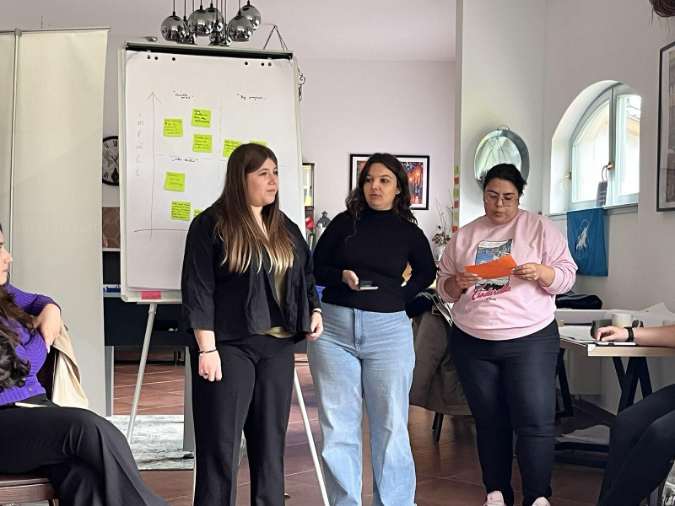
Pitching a Youth Development Project plan in front of the international group – ideas on sticky notes, then on a flipchart, then in a 4-minute pitch.
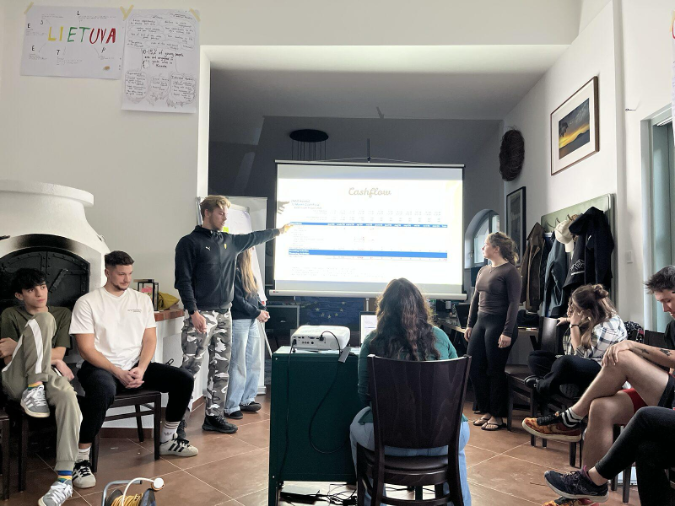
Cashflow workshop – translating an idea into a 12-month money plan, the way a small NGO actually has to live it.
4. Results & impact
Key figures
| 23 youth workers trained | 7 partner countries | 8 days of intensive learning | 1/3 participants with fewer opportunities |
| 9.2/10 overall participant rating | +30pp knowledge & skills growth | 10,000+ people reached through dissemination | 100% would recommend to a colleague |
Competence growth, measured
Before the training, 50% of participants rated their own knowledge of entrepreneurship and project management at 5/10 or lower. By the end of the week, more than 80% rated themselves at 8/10 or higher, and nobody remained below 6/10. On the closing evaluation, participants rated the overall training 9.2/10, the professional content and methods 9.1/10, and the work of facilitators and organisers 9.3/10. 100% said they would recommend the seminar to a colleague.
What participants told us
“I learned how to turn challenges into opportunities. After the project, I will use these skills in my studies and future initiatives, especially when working on group projects, creating new ideas, or managing community activities.” — Participant, Estonia
“The fact that creating a cash flow statement was part of our entrepreneurial project was really good.” — Participant, Portugal
“I’ve learnt a lot about structuring a project, and to identify problems which can then lead to new projects.” — Participant, Lithuania
Beyond the individuals
The competences travelled fast. Participants returned to their organisations and ran internal sharing sessions on the Triple Layer BMC, GANTT planning and the RACI matrix. Several partners – including BITISI (Georgia), POP HUB (Portugal) and Connecting Europe (Italy) – have already used the EYES methods in subsequent local activities, and Podjetniška akademija and ABOVE Alapítvány are co-designing a follow-up project that focuses on digital entrepreneurial skills.
5. Sharing what we learned
Dissemination strategy
From day one we treated dissemination as part of the learning, not an afterthought. The training included a dedicated session on the visibility rules of the Erasmus+ programme and on writing for an external audience. By the end of the week every participant had committed to share their experience publicly on their own channels, and the partnership had built a shared list to keep track of the outputs.
Reach: more than 10,000 people
Across LinkedIn, Instagram and Facebook posts by ABOVE Alapítvány, POP HUB, BITISI, KUNDA Sotsiaal, Connecting Europe, Podjetniška akademija and Youth Together Projects, and through the individual posts of 21 participants, the project reached an estimated 10,000+ people. Engagement on these posts surpassed 600 likes and comments. A selection of dissemination content includes:
- ABOVE Alapítvány — Instagram post and highlight reels of the mobility (Hungary).
- POP HUB — bilingual Instagram and LinkedIn posts on the Triple Layer BMC and design thinking (Portugal).
- BITISI — Facebook post reaching the wider Georgian non-formal education community.
- KUNDA Sotsiaal — Instagram carousel and Facebook story on entrepreneurial methods in rural youth work (Estonia).
- Connecting Europe — Instagram reels framing the training for Italian rural NGOs.
- Youth Together Projects — LinkedIn posts linking entrepreneurial methods to AI and innovation themes (Lithuania).
- 21 individual LinkedIn / Facebook / Instagram posts by participants, written in their own voice and language.
Visibility of Erasmus+
The official Erasmus+ logo and EU flag were visible throughout the venue, on every printed and digital workshop material, on the welcome packs, and EU funding was acknowledged on all social-media outputs. We also discussed the role of EU co-funding in making the programme possible, framing the visibility requirements as a matter of credit where credit is due.
Sustainability after the project
The partnerships are here to stay. Partners are already drafting potential follow-up initiatives: a KA2 strategic partnership with Podjetniška akademija and the Italian Connecting Europe team on digital entrepreneurial skills, and a second KA153 training course with POP HUB and KUNDA Sotsiaal on professionalising rural youth work. A shared online knowledge base – collecting the EYES methods, materials and emerging good practices – is being maintained so that the toolkit outlives any single grant cycle.
6. Lessons learned
What worked
- Treating entrepreneurship competence as a practical youth-work skill, not a business specialism, made it accessible to every participant – including those from rural and community-based organisations.
- Pairing every theoretical input with an immediate practice round (and ending the week with the Youth Development Project) translated abstract concepts into muscle memory.
- Mixed, balanced groups – experienced and less-experienced youth workers, urban and rural backgrounds, programme and partner countries – produced unusually rich exchanges.
- Daily “home group” reflections in fixed small teams created enough psychological safety to surface real questions, not just polite feedback.
- Hybrid input (Nejc Konjevič joining online for a session) proved that high-quality knowledge transfer does not always need to fly.
What we will adjust next time
- Build vegan and special-diet menus jointly with participants before arrival: after receiving feedback we adjusted quickly, but earlier alignment would have removed the friction entirely.
- Plan one optional outdoor session per training day. The neighbourhood walk on Day 2, added in response to the great weather, was rated among the most memorable moments of the week.
- Push gender balance further at the selection stage.
7. Why entrepreneurship competence is a strategic asset for European youth organisations
If we had to compress eight days of training into a single argument, it would be this: entrepreneurship competence is not a “nice to have” extra for European youth organisations, it is increasingly the difference between a project that exists and a project that endures. Public funding is becoming more competitive, donor expectations more outcome-driven, and the social challenges youth workers tackle (mental health, climate anxiety, rural exclusion, digital transitions) more systemic. In that environment, the organisations that flourish will be those whose people can read a context with PESTLE, identify a real need with a Problem Tree, communicate value in 60 seconds, draft a believable cashflow, and run a project with clear roles instead of goodwill alone.
Concretely, entrepreneurship competence pays back across at least five dimensions of an NGO’s life. First, project quality: ideas grounded in needs analysis and structured planning win more grants and produce more visible outcomes. Second, financial resilience: even a basic 12-month cashflow turns volunteer-run organisations into entities that can plan, hire, and weather delays. Third, communication: pitching skills travel everywhere — from grant interviews, to municipal meetings, to recruiting volunteers, to motivating a hesitant participant. Fourth, organisational sustainability: tools like the Triple Layer Business Model Canvas help NGOs articulate not just what they do, but the environmental and social value they generate, which is exactly the language EU strategies and modern funders now expect. Fifth, and most important, impact on young people: an entrepreneurial youth worker passes on more than a workshop. They model the very mindset – curiosity, agency, action – that Europe needs its next generation to embody.
This is why we believe entrepreneurship competence belongs at the core of European youth-work practice, not at its edges. Investing in it inside youth organisations is one of the highest-leverage uses of Erasmus+ funding we can imagine: every euro spent training a youth worker in these skills cascades into dozens of better-designed local actions, hundreds of better-supported young people, and a youth sector that no longer has to choose between idealism and feasibility. E.Y.E.S. was one step in that direction. We hope every reader of this article will take the next one.
8. Final word — the EYES, looking forward
If E.Y.E.S. has one ambition beyond the certificates we handed out in the Youthpass ceremony, it is this: to help shift the centre of gravity of European youth work – even a little – from “dreaming bigger” to “shipping better”. From projects that exist in proposals to projects that exist in communities.
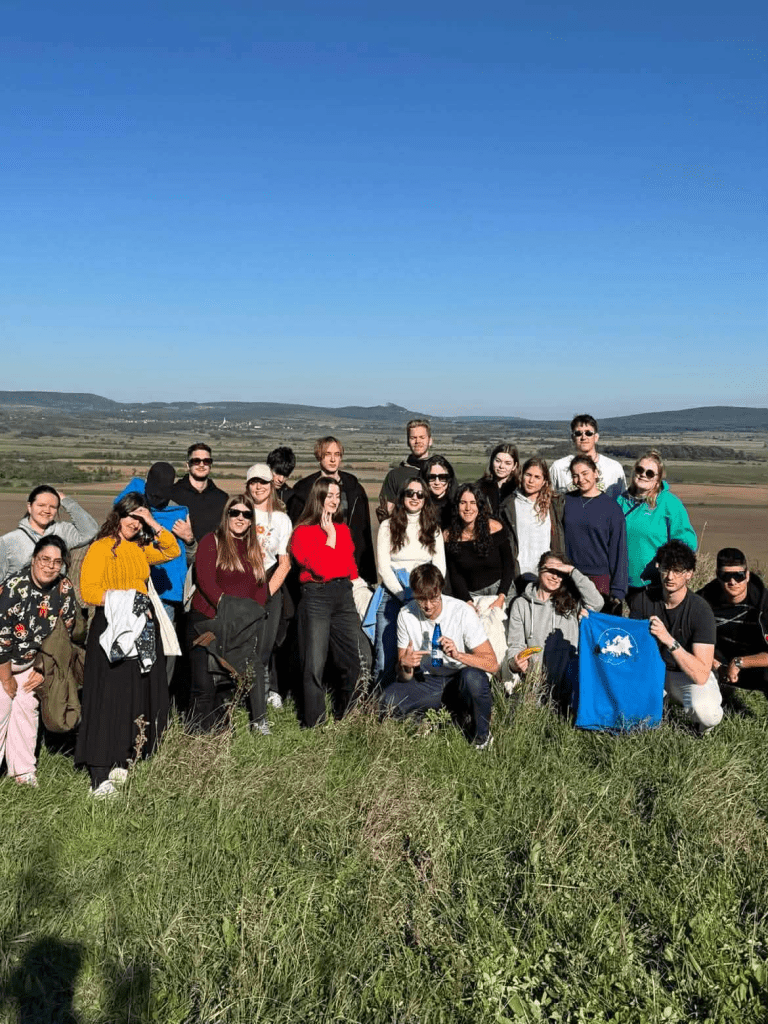
The 23 youth workers who came to Kékkút now carry that shift home, into Tbilisi and Tallinn, Postojna and Lisbon, Šiauliai and Girifalco, Veszprém and Debrecen. They carry it with PESTLE matrices in their notebooks, RACI charts on their laptops, and a network of six partner organisations one message away. That, more than any single deliverable, is the publication we are most proud of.
Acknowledgments
E.Y.E.S. would not have happened without the trust and energy of seven organisations: ABOVE Alapítvány a Fiatalok Jövőjéért (Hungary), Podjetniška akademija — društvo za izobraževanje o podjetništvu (Slovenia), ASSOCIAZIONE CONNECTING EUROPE (Italy), POP HUB — Associação (Portugal), KUNDA SOTSIAAL- JA TERVISEKESKUS MTÜ (Estonia), BITISI (Georgia) and Youth Together Projects (Lithuania). A special thank-you goes to Nejc Konjevič for the masterclass and ongoing mentoring; to facilitators Pálfy Gergő and Bocskay Ádám; to mentors Varju Szandra and Takács Bernadett; to on-site assistants Torma Zsanett and Szűcs Cintia; and to the Tempus Public Foundation (HU01) for the support throughout the project lifecycle. Above all, thank you to the 23 youth workers who turned a week in a Hungarian village into a small but real shift in how European youth work talks about getting things done.
Find out more
Project coordinator: ABOVE Alapítvány a Fiatalok Jövőjéért – Veszprém, Hungary.
Want to use these methods? All the entrepreneurial-toolkit methods in section 3 are openly shareable – the partnership encourages other youth organisations across Europe to adapt them to their own contexts, with attribution to the E.Y.E.S. project.

